The Future of Heavy Materials Resilience Is Not Just About Who Has the Biggest Kiln; It’s About Who Has the Most Insulated P&L. Run the 60-Minute Audit Before the Market Runs It for You.
By Ryan Brown
Imagine two cement plants each lose 10% of their annual shipments.
- The first sees profits cut in half.
- The second remains comfortably profitable.
Same market. Same decline. But very different outcomes.
Today, a plant manager can hit every operational key performance indicator — clinker-to-cement ratio, thermal efficiency, kiln uptime — and still watch the corporate P&L bleed out from under them.
The difference isn’t efficiency. It’s resilience.
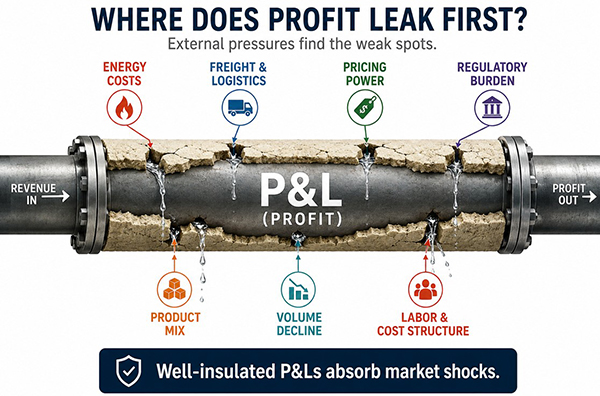
Recently, I conducted a 60-minute “P&L Insulation” audit with the executive team of a major cement producer. I asked a simple question: “If volumes fell 10% tomorrow, from where would profit leak first?”
The discussion quickly moved beyond kilns and production rates. Instead, we found ourselves examining freight costs, pricing discipline, energy exposure and product mix. That’s because downturns rarely create problems. They expose weaknesses that were already there.
The Thermal Envelope
Think of a P&L exactly like the physical insulation on a preheater tower. If someone leaves a bare spot or a cracked casing, they won’t just lose a little heat, they will compromise the thermal integrity of the entire system. An uninsulated P&L can behave the same way. When market dynamics shift, margin escapes silently and invisibly into the night before they realize they’re even bleeding.
Many cement operators track production metrics with impressive precision. They know utilization rates, maintenance costs, and fuel consumption. What is often less clear is how sensitive profits are to changing market conditions.
For example:
- What happens if fuel costs rise 20%?
- What happens if freight costs increase faster than selling prices?
- Which products become marginal first?
- Which customers stop generating meaningful profit?
- Which costs remain fixed when volumes decline?
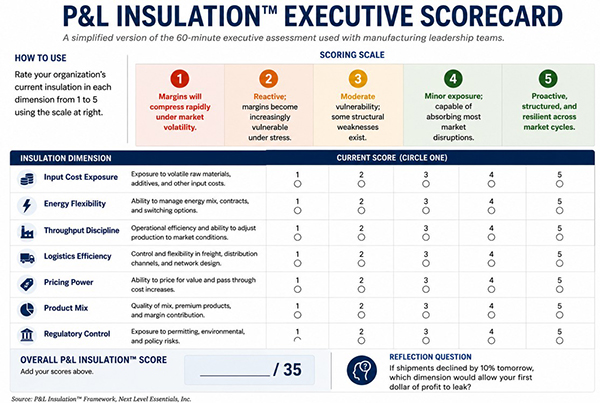
These questions form the basis of the P&L Insulation Audit — a structured discussion designed to identify where profits are most vulnerable to swings in external factors. This could mean sudden geopolitical shocks in energy markets or unexpected shifts in tariff policy.
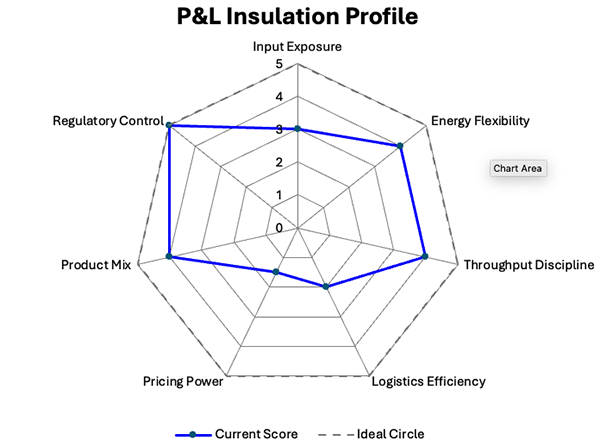
During a 60-minute conversation, we looked past traditional operational metrics and stress-tested the business against seven specific structural fragility points:
- Input Cost Exposure & Fuel Flexibility: Fuel and electricity alone can represent a massive 50% of total Cost of Goods Sold. Does your remaining energy profile sit heavily on volatile indexed structures?
- Freight Sensitivity: In some operations, logistics are a flashing red light, scoring a low 2 out of 5 for resilience. Is your operation dangerously exposed to spot freight markets and hostage to arbitrary railroad pricing?
- Pricing Resilience: Cement is historically a commodity business, and the audit laid bare a harsh reality — some plants possess little to no cost pass-through power. In one example, one region was capped at a tight $5 per ton due to localized quality and service limits.
- Throughput Efficiency and Product Mix: This is where most cement companies score well. Management is used to having absolute visibility on cost trade-offs when throughput was sub-optimal, and they actively manage high-margin product mixes.
- Regulatory Drag: Sometimes a quiet regulatory friction point is just waiting to slow down future operational pivots. Where do you face lingering permitting delays at key sites?
What might surprise some is that operational performance is not always the largest risk. A plant may run efficiently while remaining highly exposed to freight inflation or weak pricing mechanisms. Another plant may have average operating metrics but stronger commercial protections that keep margins afloat during difficult periods.
If an Enterprise Resource Planning and logistics tracking are outdated, or if a customer contracts lack index-based protections, they are essentially offering “the sleeves from their vest” to the market. The goal of the exercise is not to predict the exact date of the next market swing. The goal is to understand how the business responds under different scenarios before those scenarios occur.
Conclusions
Pilots don’t wait for an actual engine failure to understand how their aircraft will respond. They test it beforehand in a simulator.
In the same way, producers can think similarly about profitability.
Markets will fluctuate. Fuel costs will move. Demand cycles will come and go.
The bottom lines that perform best are rarely the ones that forecast perfectly. They are the ones that best understand their vulnerabilities before the table setting is rearranged.
A simple one-hour resilience discussion can reveal more about future profitability than months of looking back at historical results.
The next downturn won’t create weaknesses in your operation. It will simply reveal the ones that already exist.
Ryan Brown has worked in the Building Materials sector for nearly 30 years. As founder and managing director of Next Level Essentials LLC, he delivers bottom-line impacts in operational improvement, supply chain optimization, and post-merger integration. He can be reached at ryan.brown@nextlevelessentials.net.